> For the complete documentation index, see [llms.txt](https://docs.liquiflow.app/llms.txt). Markdown versions of documentation pages are available by appending `.md` to page URLs; this page is available as [Markdown](https://docs.liquiflow.app/section-settings/sections.md).
# Sections
## Sections
Each `li-settings` tag needs to be enclosed within a section. For this purpose, use the `li-section` tag, which can be applied to your Webflow sections. You have the flexibility to choose a name for it, with a maximum limit of 30 characters.
{% code title="Webflow" fullWidth="false" %}
```
li-section = Section Name
```
{% endcode %}
{% columns %}
{% column %}
{% endcolumn %}
{% column %}
{% endcolumn %}
{% endcolumns %}
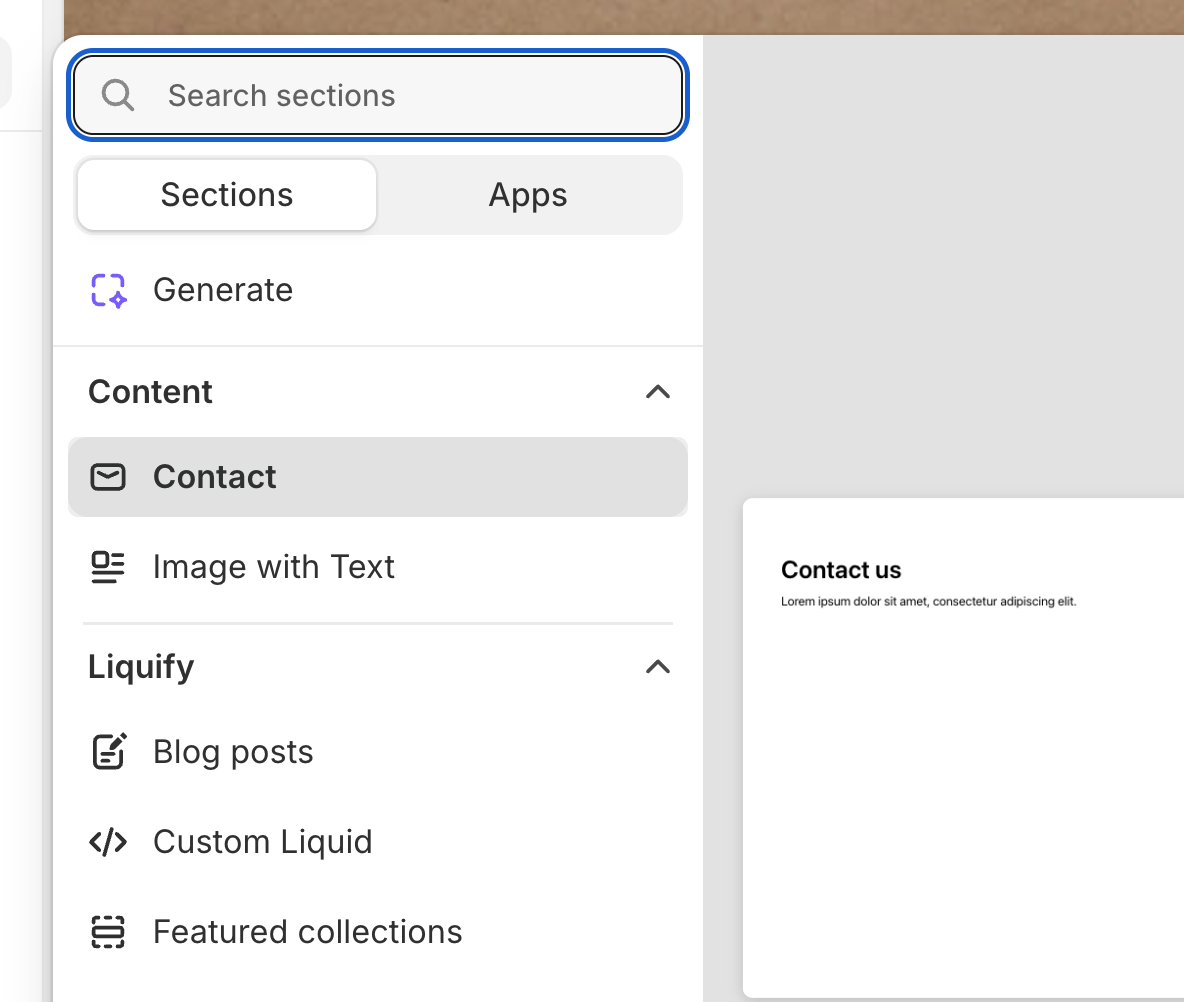
#### Section Categories
For a better overview in the Shopify Editor, you can add a section to a category by adding the attribute li-section:category. The value of this attribute will then be the name of the category.
{% code title="Webflow" fullWidth="false" %}
```
li-section:category = Category Name
```
{% endcode %}
## **Section Groups**
[Section groups](https://shopify.dev/docs/storefronts/themes/architecture/section-groups) are typically used for the header and footer. They are JSON data files that define a list of sections and app blocks along with their settings. Merchants can add, remove, and reorder these sections within the theme editor.
Simply add the `li-section-group` attribute to a `
` element and place your sections inside it — for example, the Navigation section.
{% code title="Webflow" fullWidth="false" %}
```
li-section-group = Section Group Name
```
{% endcode %}
{% hint style="warning" %}
* Section groups are not allowed inside the `li-content-for-layout` element
* Section groups cannot have the same name as other section
* Changes made to the section group will be reflected on all pages where the group is used
{% endhint %}
To define the type of a section group, use the `li-section-group:type` attribute. This helps Shopify determine where the section group is used. Accepted values:
* `header`
* `footer`
* `aside`
* A custom type, in the format `custom.`, where `` is a unique identifier for your section group type.
{% code title="Webflow" fullWidth="false" %}
```
li-section-group:type = header
```
{% endcode %}
## **Enable or disable Sections in the Shopify Editor**
**Enable**: If you want to show certain sections only on specific templates, you can use the tag modifier `li-section:on_templates`. In the value, list all the templates where the section should be shown, separated by commas. To show the section on all templates, just use `*`.
See the official [Shopify documentation](https://shopify.dev/docs/storefronts/themes/architecture/sections/section-schema#enabled_on) for more information on this topic.
{% code title="Webflow" %}
```
li-section:on_templates = page, product
```
{% endcode %}
You can do the same for section groups using the tag modifier. To target all groups, just use `*` in the value.
{% code title="Webflow" %}
```
li-section:on_groups = footer, header
```
{% endcode %}
**Disable**: If you want to hide certain sections on specific templates, use the tag modifier `li-section:off_templates`. List the templates (comma-separated) where the section should be hidden. To hide the section on all templates, use `*` in the value.
See the official [Shopify documentation](https://shopify.dev/docs/storefronts/themes/architecture/sections/section-schema#disabled_on) for more information on this topic.
{% code title="Webflow" %}
```
li-section:off_templates = page, product
```
{% endcode %}
You can do the same for section groups using the tag modifier. To target all groups, just use `*` in the value.
{% code title="Webflow" %}
```
li-section:off_groups = footer, header
```
{% endcode %}